First-Time Home Buyer Programs: What's Available in 2026
First-Time Home Buyer Programs: What's Available in 2026
I was sitting down with a young professional in Toronto last week. She’s been renting for years, saving diligently, and she’s finally ready to buy. But she looked at me and said, "Greg, I know there are programs out there. I just have no idea what’s still available and what’s changed."
She’s not alone. The landscape of first-time buyer programs in Canada shifts regularly. Some programs get a major boost, others quietly disappear. If you’re buying your first home in Ontario, Alberta, B.C., or Quebec, here’s exactly what’s available now to help make it happen.
The Home Buyers' Plan (HBP)
What it is: This is still the heavyweight champion of first-time buyer programs. It allows you to withdraw funds from your Registered Retirement Savings Plan (RRSP)tax-free to put toward your down payment.
The key number: As of April 2024, the limit was increased from $35,000 to $60,000 per person. That means a couple buying together could access up to $120,000 for their down payment.
Repayment: You have 15 years to pay the money back into your RRSP. No penalties or taxes as long as you make the annual repayments on time.
Who qualifies: You’re considered a first-time buyer if you haven’t owned a home in the last four years. This rule applies across all provinces.
Provincial note: This is a federal program, so it works the same way in Ontario, B.C., Alberta, and Quebec. Your RRSP must be with a Canadian financial institution.
The First Home Savings Account (FHSA)
What it is: This is the newest tool in the toolbox, launched in 2023. It’s a registered account designed specifically for first-time buyers.
How it works: You can contribute up to $8,000 per year, to a lifetime maximum of $40,000. Contributions are tax-deductible (like an RRSP), and withdrawals to buy your first home are tax-free(like a TFSA).
The triple win: You get a tax break when you put money in, tax-free growth while it’s invested, and tax-free access when you pull it out for your purchase.
Who qualifies: Same first-time buyer definition as the HBP. You can hold this account at most major banks and credit unions across Canada.
Can you use both HBP and FHSA?
Yes, absolutely. This is the power move. You can max out your FHSA ($40,000) and use the HBP ($60,000) for a total of $100,000 per person in tax-advantaged down payment funds. For a couple, that’s a potential $200,000 down payment.
The First-Time Home Buyer Tax Credit (HBTC)
What it is:A non-refundable tax credit to help offset closing costs like legal fees, inspections, and transfer taxes.
The amount: It was increased to $1,500 for purchases in 2023 and subsequent years. You claim it on your tax return for the year you buy the home.
Who qualifies: First-time buyers (same definition) or those eligible for the Disability Tax Credit.
The GST/HST New Housing Rebate
What it is: If you buy a newly built or substantially renovated home(or do a major renovation), you may qualify for a rebate on part of the GST/HST you paid.
The maximum rebate: Up to $6,300.
Eligibility: The purchase price must be under $450,000 for the full rebate (partial rebate up to $450,000). You or a close relative must occupy the home as your primary residence.
Provincial note: This rebate works differently in provinces with their own provincial sales tax (like Quebec). In Quebec, you deal with Revenu Québec for the QST portion. We’ll connect you with the right resources.
Green Home Programs (CMHC, Sagen, Canada Guaranty)
What they are: If you buy an energy-efficient home or make energy-saving renovations, you may qualify for a premium refund on your mortgage insurance.
The benefit: Up to 25% premium refund from CMHC, Sagen, or Canada Guaranty.
Requirements: The home must meet specific energy-efficiency standards (like an EnerGuide rating). You’ll need a completed energy assessment.
Provincial note: This is available nationwide. In Quebec, Canada, Guaranty and Sagenare are active alongside CMHC.
What's No Longer Available: The FTHBI
Just so you have the full picture: The First-Time Home Buyer Incentive (FTHBI)—a shared-equity program where the government took a stake in your home—was discontinued in March 2024.
If you already have a mortgage that used the FTHBI and have questions, you’ll need to reach out to the broker who originated that file.
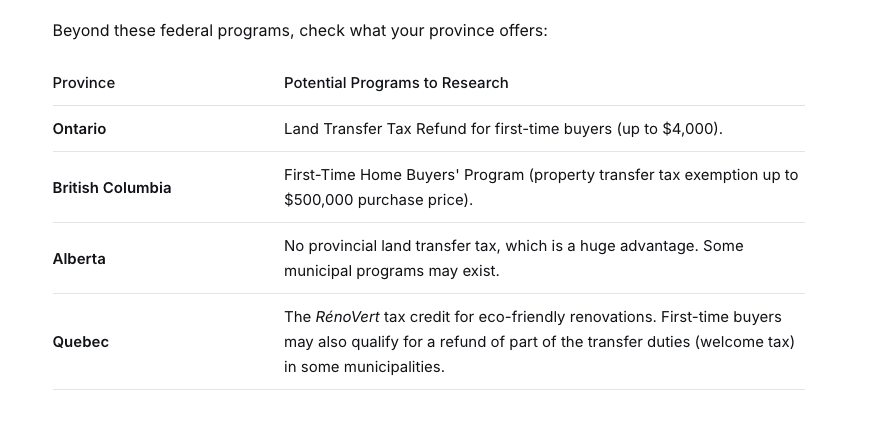
Provincial Programs to Layer On
Beyond these federal programs, check what your province offers:
The Power Play: Stacking Programs
The real magic happens when you stack these programs together.
Let’s use an example in Calgary:
Sarah uses her FHSA ($40,000) and HBP ($60,000) for a $100,000 down payment.
She buys a newly built home for $425,000, qualifying for the GST New Housing Rebate.
The home is energy-efficient, so she applies for the CMHC Green Home premium refund.
She claims the $1,500 HBTCon on her next tax return.
That’s multiple programs working together to make homeownership more affordable.
Common Questions We Get
What's the best account to save in right now?
The FHSA is the most powerful savings vehicle for a first-time buyer. Use it first, then layer in your RRSP for the HBP if you need more.
Can I use the HBP if I don't have an RRSP yet?
Yes, but you need to have funds in an RRSP for at least 90 days before withdrawal. Plan ahead.
Do these programs work for a pre-construction condo?
Yes, but timing matters. You usually need the funds available when you close, which could be years after you sign. Talk to us early.
Let's Map Out Your First Purchase
Buying your first home is a big step. But the programs are there to help—you just need to know how to use them.
Whether you’re saving in an FHSA, tapping your RRSP, or stacking multiple programs across provinces—let’s talk. We’ll run your numbers, explain exactly what you qualify for, and build a plan to get you there.
Give us a call or fill out an application at this link. Our team will get in touch to start building a plan that suits your situation, wherever you are in Canada.


