
Purchase Plus Improvements: Turn a Fixer-Upper Into Your Dream Home
Purchase Plus Improvements: Turn a Fixer-Upper Into Your Dream Home
I was talking to a young couple in Ottawa last month. They’d been looking for months, but every move-in ready home in their budget felt like a compromise. Then they found the one—a solid older home in a great neighbourhood. It just needed a new kitchen and a bathroom refresh.
They looked at me and said,"Greg, we love it, but we don't have cash left for the Reno's after the down payment. Is this even possible?"
If you're nodding along, whether you're in Toronto, Vancouver, Calgary, or Montreal, I have good news: yes, it's possible. It's called a Purchase Plus Improvements mortgage, and it might be exactly what you need.
What Is a Purchase Plus Improvements Mortgage?
A Purchase Plus Improvements mortgage gives home buyers the flexibility to upgrade or improve their newly purchased property. It allows you to borrow the cost of renovations and roll that amount into your total mortgage, all with as little as 5% down on the total amount (purchase price + renovations).
Think of it as one simple mortgage that covers both the home and the work you need to do to make it yours.
How much can you borrow for renovations?
As a rule of thumb, renovations permitted under this program must enhance the value of the home. The typical limit is around $40,000, but we often see exceptions granted for up to $100,000in improvements, depending on the lender and the property's value.
How Does It Actually Work?
Here's the step-by-step process we guide clients through across the country:
Step 1: Get pre-approved.Start with a pre-approval so you know exactly what you can afford, including the renovation budget.
Step 2: Find the home and get quotes. Once you've found the right property, take a licensed contractor with you (or have them visit separately) to provide a detailed, firm quote for the work you want done. This needs to be comprehensive—lenders want to see exactly what they're funding.
Step 3: Make your offer. Your real estate agent helps you make an offer based on the home's current condition. Once it's accepted, you send your mortgage broker both the signed offer and the contractor's quote.
Step 4: Secure approval. Your broker works with the lender to approve a mortgage that covers both the purchase price and the renovation costs.
Step 5: Close on the home. On your possession date, your lawyer advances the purchase funds to the sellers. You take ownership of the home.
Step 6: Complete the renovations. You now have a set timeline—typically 90 days from the possession date—to get the work done.
Step 7: Inspection and funds release. Once the work is complete, the lender sends an inspector to confirm that everything was done as outlined. After approval, your lawyer releases the renovation funds to either you or your contractor.
Step 8: Enjoy your dream home.
A Real-World Example
Let's use a concrete example to show how the math works:
You find a home in Hamilton for $600,000. It needs $35,000 in kitchen and bathroom updates.
Your total mortgage becomes $635,000.
You make a 5% down payment on that total amount:$31,750.
On closing day, the seller gets their $600,000.
You move in and complete the renovations within 90 days.
Once the work is inspected and approved, the$35,000is released to pay your contractor.
What Properties Are Eligible?
This program works across Canada, but there are consistent rules:
The property must be a maximum off our units.
At least one of those units must be occupied as your principal residence (this isn't for pure investment properties, though a rental suite within your home is fine).
The home can be new construction or an existing home.
Can You Use This to Build a Secondary Suite?
Yes—and this is where it gets powerful.
If you want to use a Purchase Plus Improvements mortgage to build a secondary suite for rental income, you can actually use that potential rental income to qualify for a higher mortgage amount—before the renovations are even completed.
This is a game-changer in expensive markets across Ontario and B.C., and it's also popular in Alberta for buyers looking to offset their mortgage with a basement suite.
Important Timing Details
When Do You Get the Renovation Funds?
The funds for renovations are dispersed after the work is completed. This is critical to understand. You need to have a plan with your contractor about when payment is expected.
Some contractors may require deposits or progress payments. You'll need to cover those upfront—through savings, a line of credit, or credit cards—and then get reimbursed when the lender releases the funds.
Can Funds Be Released in Stages?
Yes, some lenders offer progress draws. For example, if you're doing a six-month renovation totaling $75,000, and you complete the garage first, the lender may advance a portion of the funds at that point. This helps with cash flow during longer projects. We can help find a lender that offers this flexibility.
What's the Typical Timeline?
Most lenders require the renovation work to be completed within 90 days of the mortgage funding. Extensions are sometimes possible depending on the circumstances, but you need to discuss this upfront.
What If You're Doing the Work Yourself?
If you're handy and planning to DIY, you can still use this program—but there's a catch.
The lender will only cover the cost of materials, not your labour. You'll need to:
Keep all your receipts for materials purchased.
Provide proof of payment before the lender will advance the funds.
Complete the work to a professional standard (the inspector will check).
What If You Decide Not to Complete the Renovations?
Life happens. If you decide not to go ahead with the planned renovations after your mortgage has already been funded, the portion of funds allocated for improvements will simply be put toward your principal.
However, it's important to note that your mortgage payment will remain the same for the duration of your term, as the mortgage agreement has already been finalized.
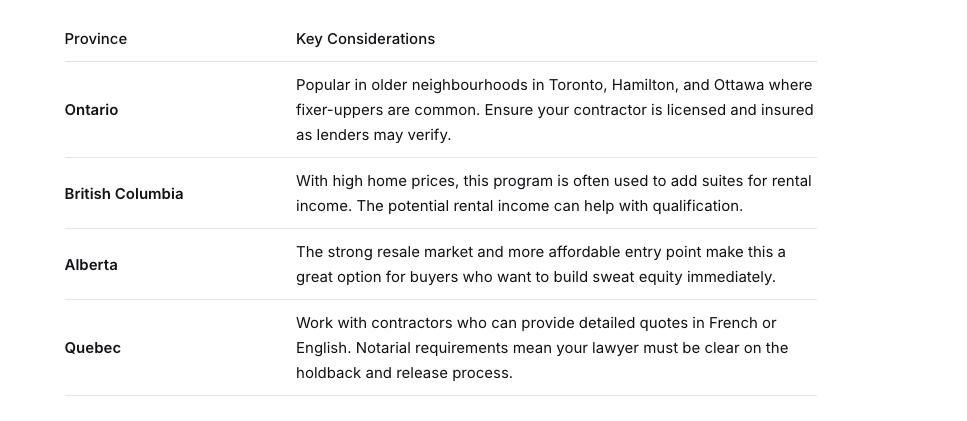
Provincial Nuances to Keep in Mind
Common Questions We Get
Can I include appliances in the renovation costs?
Generally, yes—if they're built-in or permanently installed. Think new cabinets, countertops, and built-in ovens. Free-standing fridges and washers are usually not included.
What if the renovations cost less than the quote?
The funds advanced will be based on actual costs, up to the approved amount. If you come in under budget, the leftover funds go toward your principal.
What if they cost more?
You're responsible for any overages. That's why getting a firm, detailed quote upfront is so important.
Do I need to use specific contractors?
Lenders don't typically require specific contractors, but they do expect licensed, insured professionals. DIY is allowed for materials only.
Let's Talk About Your Fixer-Upper
If you've found a home with good bones that just needs some love, a Purchase Plus Improvements mortgage might be your perfect tool. Whether you're in Ontario, B.C., Alberta, or Quebec, we can help you structure the deal.
Give us a call or fill out an application at this link. Our team will get in touch to start building a plan that turns that fixer-upper into your dream home.


