
Your Home Has Been Working. Are You Using It?
Most Ontario Homeowners Are Sitting on Equity They've Never Touched
If you bought a home in Ontario more than three years ago, there's a good chance your property has done more heavy lifting than you realize.
Markets across the GTA, Ottawa, Hamilton, Kitchener-Waterloo, and beyond have seen significant appreciation over the past decade. That value doesn't just sit there for the day you sell.
There's a way to put it to work right now — without giving up your mortgage rate, without refinancing, and without taking on rigid fixed payments.
It's called a HELOC.
And most Ontario homeowners either don't have one or don't fully understand what it can do.
Let me break it down.
What Is a HELOC, in Plain Language?
A HELOC — Home Equity Line of Credit — is a revolving line of credit secured against your home.
Think of it like a high-limit credit facility attached to your property. Except instead of paying 20%+ interest like a credit card, you're borrowing at rates tied to bank prime.
As of early 2026, bank prime in Canada sits at4.45%. HELOC pricing typically runs fromPrime + 0% to Prime + 1%depending on your lender and credit profile.
Here's how it works:
You borrow up to65% of your home's appraised value
You only pay interest on what you actually draw
You can repay and re-borrow without reapplying
Interest-only payments are an option
Minimum20% equityis required to qualify
It's flexible by design.
And in the right hands, it's one of the most powerful tools in a homeowner's financial structure.
When a HELOC Makes More Sense Than Refinancing
This is where most people get the math wrong.
A lot of Ontario homeowners locked in rates under 3% before the Bank of Canada hike cycle. Refinancing today means replacing that rate with something significantly higher.
That's not always a smart trade.
A HELOC lets you access equitywithout touching your existing mortgage. The two products sit beside each other. Your low rate stays intact. You open a credit facility on top of it.
This makes sense when:
You want liquidity without restructuring your mortgage
You're planning renovations and want to draw funds in stages
Your income is variable and you need flexible access to cash
You want a financial reserve without paying interest until you use it
We don't guess at which option is better.
We run the numbers on both — and show you exactly what each one costs over your term.
HELOC vs. Refinance vs. Second Mortgage — What's the Difference?
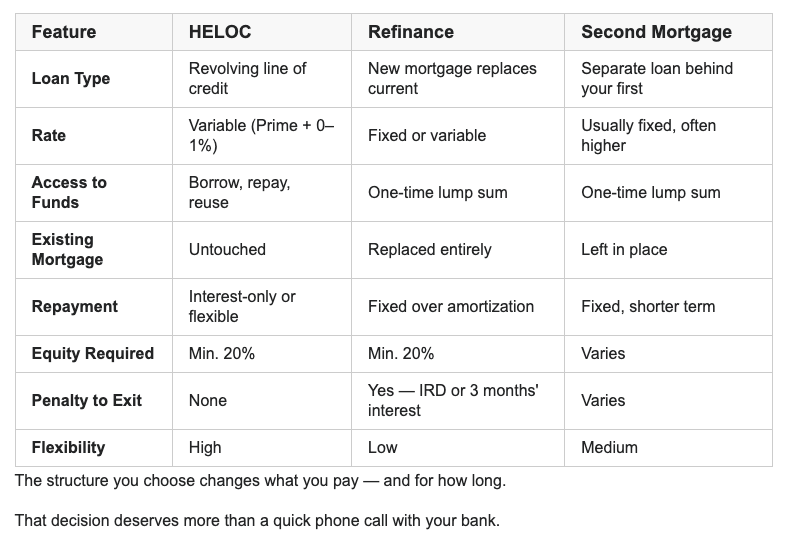
The Best Time to Add a HELOC? At Renewal.
Most Ontario homeowners miss this window.
When your mortgage term ends, you can restructure without penalties. You're not breaking your mortgage — you're choosing a new setup as part of a natural transition.
Adding a HELOC at renewal gives you:
Access to equity without future refinancing costs
Flexibility for renovations, investments, or life events
A financial reserve that costs you nothing until you use it
This is a conversation worth havingbeforerenewal, not after.
Because once you've signed a new term with a lender that doesn't offer a HELOC product, that window closes for another 3 to 5 years.
How Much Can You Actually Borrow?
The math is straightforward.
HELOCs are capped at65% of your home's appraised value. But if the HELOC is bundled with your mortgage at the same lender, the combined borrowing can reach up to80%.
Ontario Example:
Home value: $850,000(a reasonable number across much of the GTA, Hamilton, or Ottawa)
Mortgage balance: $480,000
80% of $850,000 = $680,000
Available HELOC room =$200,000
That's $200,000 in accessible credit — at prime-linked rates — ready to deploy on your terms.
Even when the math supports it, lenders will still assess your income, credit score, and existing debt load before granting full access.
We look at this before you apply so there are no surprises.
How to Qualify for a HELOC in Ontario
To qualify, most lenders need to see:
Minimum 20% equityin the property
Credit score of 680 or higher
Provable income— T4, self-employed, or business income structured correctly
Debt service ratios within guideline
A current appraisalconfirming market value
You also need to pass thefederal stress test— qualifying at the greater of the Bank of Canada benchmark rate or your contract rate plus 2%.
This is where income structure matters.
Self-employed Ontario homeowners often have the equity and the real earnings — but the income isn't always presented in a way lenders recognize. We fix that before it becomes a problem.
Which Lenders Offer HELOCs in Ontario?
Choice Financial works with Ontario lenders offering HELOC products, including:
Scotiabank STEP— Combined mortgage and HELOC structure, widely available across Ontario
TD Flexline— HELOC with option to lock segments at fixed rates
Manulife One— Blends daily banking with mortgage and HELOC in one account
RBC Homeline Plan— Revolving HELOC alongside your mortgage
National Bank All-In-One— Flexible HELOC-forward product for Ontario borrowers
Not every lender's HELOC product is structured the same way.
We compare them — and show you what the difference actually costs over time.
Ontario Case Study — Real Numbers
Client:Couple in Mississauga, Ontario
Home value:$950,000
Mortgage:$510,000 at 2.49%, insured, due 2027
Goal:Fund a major kitchen and basement renovation without refinancing their low fixed rate
Strategy:Added a HELOC for $250,000 (80% of $950,000 minus $510,000). Drew $120,000 at Prime + 0.5% = 4.95%. Interest-only payments came to approximately $495/month.
Result:They kept their sub-2.5% mortgage rate, completed the renovation on their schedule, and drew funds in phases — only paying interest on what they used. No refinancing penalty. No fixed payment increase.
That's structure doing the heavy lifting.
Key Terms — Defined Simply
HELOC:Home Equity Line of Credit — revolving credit secured by your home
Equity:What your home is worth minus what you owe
Loan-to-Value (LTV):Your loan balance as a percentage of your home's value
Refinance:Replacing your existing mortgage with a new one
Second Mortgage:A separate loan registered behind your first mortgage
Stress Test:Federal rule requiring qualification at a higher rate than your contract
Revolving Credit:Credit you can borrow, repay, and reuse
Appraisal:A professional valuation of your property
Prime Rate:The bank's base lending rate — what your HELOC is priced against
Frequently Asked Questions
Can I get a HELOC alongside my current mortgage?
Yes — in most cases. The key is whether your current lender offers a compatible HELOC product, and whether your equity and income qualify. We assess this before you commit to anything.
Is a HELOC better than refinancing?
If you're holding a mortgage rate below current market levels, almost always. We run both scenarios and show you the real cost comparison. The answer isn't always obvious until you see the math.
Can I use a HELOC to consolidate debt?
Yes — and it can dramatically reduce your interest cost. But it only works with a clear repayment plan built in. Without structure, you're just moving debt around. With structure, you can eliminate it efficiently.
Do HELOC rates change?
Yes. HELOCs are variable-rate products tied to bank prime. If prime increases, your rate increases. We factor this into the analysis so you know what you're working with at different rate scenarios.
Can I pay off a HELOC early?
Yes, fully and at any time, with no penalty. That's one of the core advantages — maximum flexibility on repayment.
What if I'm self-employed?
Income structure matters significantly here. Many self-employed Ontario homeowners qualify — but how their income is documented changes which lenders will approve them and at what limit. We work through this upfront.
Here's the Move
If you own a home in Ontario and you haven't had a conversation about what your equity can actually do — that's the gap.
Not because you have to use it.
But because you should know what's available.
Let's look at your current mortgage, your equity position, and the real numbers behind adding a HELOC to your structure.
No pressure. Just math.
DM me"Equity"and we'll start there.


