
Downpayment 101: What You Need to Know Before You Buy
Downpayment 101: What You Need to Know Before You Buy
I was on the phone with a young couple from Ottawa the other day. They’re renting, they’re saving, and they’re ready to buy—but they kept coming back to the same question: "Greg, how much do we actually need to put down? And where can it come from?"
If you’re nodding along, you’re not alone. The down payment is the biggest hurdle for most first-time buyers across Canada. But here’s the thing—it’s not as complicated as it seems once you break it down.
Let’s walk through the basics: the minimums, the rules, and where your money can actually come from, whether you're buying in Toronto, Vancouver, Calgary, or Montreal.
The Three Types of Down Payment Scenarios
Your down payment amount doesn’t just affect how much you borrow—it changes the type of mortgage you get and the rules around it.
1. High Ratio Mortgage (5% – 19% down)
A down payment of between 5% and 19% of the purchase price is called a "high ratio mortgage." Why? Because your loan is more than 80% of the home’s value.
For this reason, lenders require you to purchase default mortgage insurance(often from CMHC, Sagen, or Canada Guaranty). This insurance protects the bank if you stop paying, but you pay the premium. It gets added directly to your total mortgage amount.
Minimum down payment rules across Canada:
Under $500,000:5% minimum
$500,000 – $999,999:5% on the first $500k, 10% on the portion above
$1 million or more:20% minimum (no insurance available)
2. Conventional Mortgage (20%+ down)
A down payment of 20% or more is a "conventional mortgage." Because your loan is 80% or less of the home’s value, you don’t need mortgage insurance. This can save you thousands in premiums and sometimes gets you a slightly better rate.
3. Flex-Down Mortgage (Less than 5% down)
These aren’t as common as they used to be, but they still exist. A "flex-down" mortgage allows borrowers with strong income to borrow their 5% down payment from an unsecured line of credit.
If you have solid income but you’re just struggling to scrape together the down payment—especially with rising rents eating your savings—this might be an option. It’s not for everyone, but we’ve made it work for clients across the country.
Where Can Your Down Payment Come From?
Here’s the part that surprises most people. Your down payment doesn’t have to be a single pile of cash you’ve been hoarding under the mattress. Lenders accept several sources, but each has specific rules.
Cash Down Payment (Savings, Chequing, Investments)
This is the most straightforward. Any cash you use must be verified with 90 days of history. We’ll need bank statements showing your name, account number, and the funds sitting there for at least three months.
Provincial note: If your down payment is coming from overseas (common in B.C. and Ontario), those foreign bank statements may need a certified translation into English or French.
Gifted Down Payment (From a Direct Family Member)
This is huge for first-time buyers. You can receive a gift from a parent, grandparent, sibling, or child—but it must come with no obligation to repay.
We’ll provide you with a standard gift letter that both you and the donor sign, confirming the funds are a true gift, not a loan.
Rule by residency:
Permanent Residents:100% of your down payment can be a gift.
Work Permit Holders: At least 5% of the purchase price must come from your own savings. The rest can be a gift.
RRSPs (The Home Buyers' Plan)
The federal government has an incredible program: you can withdraw up to$35,000from your RRSP tax-free for a down payment, and you have 15 years to pay it back.
Important: You don’t have to be a first-time buyer anymore if you've experienced a breakdown of a marriage or common-law partnership. Talk to us about the rules.
We’ll need the withdrawal form from your financial institution and your RRSP statement. Easy.
What if you're not a first-time buyer?
You can still pull RRSP funds for a down payment—but the financial institution will withhold 30% for taxes right off the top. Not ideal, but totally possible if you need the cash.
Borrowed Against an Existing Property
If you already own a home (or an investment property), you can borrow against its equity for a down payment on a new purchase. This works if you have enough available equity.
We’ll need mortgage statements showing your current available equity.
Sale Proceeds
You may be selling an existing property and using the proceeds for your next down payment. This is common for move-up buyers across all provinces.
We’ll need:
The firm sale contract
Your current mortgage statement
Confirmation of the sale proceeds deposited into your account
Timing tip: If your sale closes after your new purchase, you may need bridge financing to cover the down payment in between. We handle this all the time—it’s a short-term solution that keeps your deal on track.
Unsecured Lines of Credit
As mentioned in the flex-down scenario, some borrowers with high income can qualify by borrowing their 5% down payment from an unsecured line of credit.
This strategy isn’t for everyone. But with rising rents and a competitive market from Victoria to Halifax, more buyers are choosing to stretch a little to own instead of rent. We can run the numbers and tell you if it makes sense for your situation.
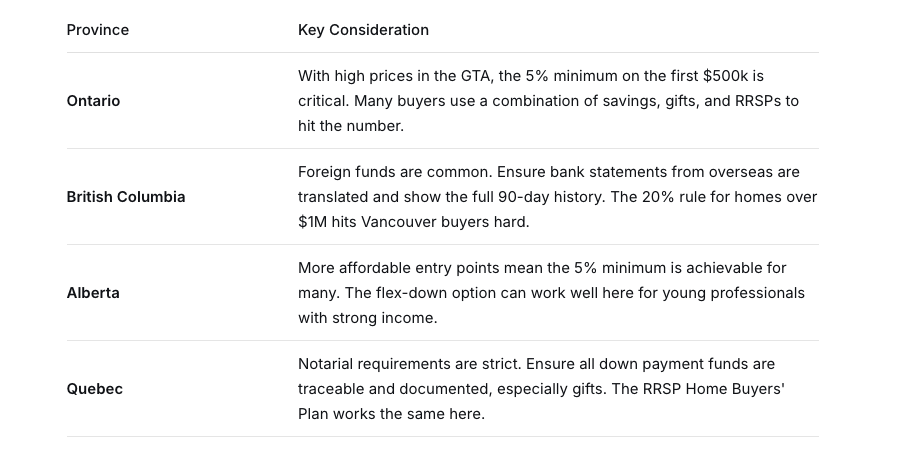
Provincial Nuances to Keep in Mind
Common Questions We Get
Can I use my TFSA for a down payment?
Yes. Funds in a TFSA are treated like cash savings. You just need to show the 90-day history. Withdrawals are tax-free.
Do I need the full 90-day history if the money just arrived?
Yes. If a large deposit shows up last week, the lender will want to see where it came from (gift, sale of an asset, etc.). Plan ahead.
Can my down payment be in cryptocurrency?
It’s complicated. Most A-lenders won't touch crypto funds directly. You'd likely need to sell, move the cash to a bank account, and let it sit for 90 days.
What about the first-time home buyer incentive?
That program has changed and is less common now. We can discuss current government programs in your province, but cash, gifts, and RRSPs remain the main sources.
Let’s Map Out Your Down Payment Strategy
The down payment is the first big step. But it doesn’t have to be a mystery.
Whether you’re leaning on savings, a family gift, your RRSP, or even a line of credit—let’s talk. We’ll run your numbers, explain exactly what you need, and build a plan to get you there.
Give us a call or fill out an application at this link. Our team will get in touch to start building a plan that suits your situation, wherever you are in Canada.


