
How to Position Yourself to Build a Rental Portfolio in Canada
How to Position Yourself to Build a Rental Portfolio in Canada
I was grabbing coffee with a buddy of mine in Hamilton last month. He’s got a good job, a bit of equity in his home, and he’s been thinking about buying a rental property. He looked at me and said,"Greg, I see all these Instagram gurus talking about portfolios. But for a regular guy like me, is this actually possible?"
If you’re in that early stage—wondering if building a rental portfolio is even possible with your income, credit, or current mortgage—this one’s for you.
Let’s talk about how to set yourself up properly across Canada. No hype, no overleveraging. Just a smart, sustainable game plan rooted in real numbers.
What Lenders Are Really Looking For on a Rental Purchase
Buying a rental isn’t the same as buying your own home. Lenders see extra risk in investment properties, so they’ll dig deeper. They’ll examine your down payment, your debt load, your income—and the property’s cash flow itself.
Here’s what they care about most, whether you're buying in Toronto, Vancouver, Calgary, or Montreal:
Minimum down payment: For a rental, you need at least20% down. CMHC-insured mortgages don’t apply to investment properties. This is consistent across Canada.
Qualifying (stress) rate: Even if your actual rate is lower, you’ll need to qualify at a higher "qualifying rate" to ensure you can handle future increases.
Rental income treatment:This is where it gets nuanced. Some lenders use the rental offset method(subtracting a portion of rent from your mortgage payment), while others use an add-back method(adding 80% of rent to your income). The method changes your capacity to borrow.
Cash flow buffer: The property should ideally generate positive cash flow after mortgage, taxes, and expenses. If there’s a shortfall, your personal income needs to cover it.
Your documented income: Especially for self-employed clients, clean financials (Notices of Assessment, T1s) are essential. Lenders get pickier with each property you add.
How to Position Yourself Financially
You don’t need to start with perfect finances—but youdoneed a clear, disciplined foundation. Most portfolios grow from three strengths:
1. Your Primary Residence
Your home often holds hidden launching power. After living in it for years, it may have built equity. By refinancing or using a HELOC, you can free up capital to use as a down payment.
Example across markets:
Your home in Calgary is worth $550,000, with a mortgage of $350,000. At 80% loan-to-value, you could tap up to $90,000 in equity.
In Toronto, a home worth $1.2M with a $500,000 mortgage could yield $460,000 in accessible equity at 80% LTV.
That equity becomes your down payment on a rental.
2. Clean, Documented Income
You don’t need to be rich—you need to be verifiable. If you’re on payroll, that helps. If you're self-employed, we’ll work together to organize your Notices of Assessment, tax returns, and supporting documents so lenders feel confident in your income.
3. Smart Property Selection
Even with higher rates, good properties still exist. The trick is picking ones that give you breathing room.
Sample Scenario: A $450,000 Duplex (Red Deer, AB)
Purchase Price: $450,000
Down Payment (20%): $90,000
Mortgage Amount: $360,000 (30-year amortization)
Monthly Mortgage Payment: ~$1,842 (at 4.54%)
Monthly Rent (upper + lower): $2,700
Property Taxes: $250
Insurance & Misc.: $100
Cash Flow (pre-repairs): ~$500/month
That buffer gives you breathing space for vacancies, maintenance, or unexpected costs.
Sample Scenario: A $650,000 Triplex (London, ON)
Purchase Price: $650,000
Down Payment (20%): $130,000
Mortgage Amount: $520,000 (30-year amortization)
Monthly Mortgage Payment: ~$2,660 (at 4.54%)
Monthly Rent (three units): $3,900
Property Taxes: $400
Insurance & Misc.: $150
Cash Flow (pre-repairs): ~$690/month
Case Study: From a Basement Suite to Four Doors
Let me give you a real example from a client in Airdrie, Alberta—but this blueprint works anywhere.
Client profile: A married couple in their early 30s—one teacher, one self-employed contractor.
Starting point: Their primary home had a legal basement suite bringing in $1,200/month. They refinanced to pull $70,000 in equity.
First rental: They purchased a duplex in Lethbridge for $375,000. With $75,000 down and a mortgage of $300,000, their monthly payment was around $1,535. They collected $2,400 in rent from both units.
Next step: After one year, with clean rental income history and organized taxes, they qualified for another property—a single-family rental in Grande Prairie.
Why it succeeded: They had steady personal income, kept the properties' cash flow positive, and didn’t overextend. Their documents were in order, which made the lender's underwriting smoother.
Provincial Nuances for Rental Investors
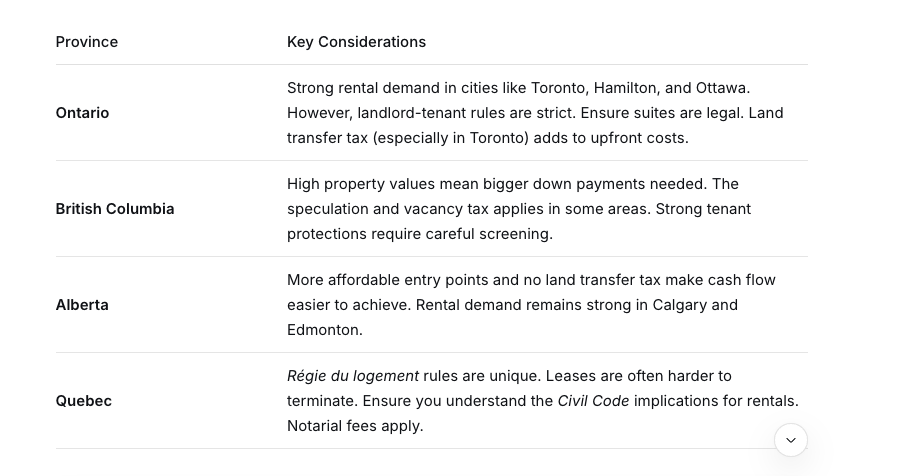
Mistakes We’ve Helped Clients Avoid Across Canada
Over the years, we’ve seen how easy it is for well-meaning investors to get ahead of themselves.
The pre-construction trap: A couple from Calgary jumped on a pre-construction fourplex after a seminar. The numbers looked good, but they hadn't confirmed financing. When closing day came, they were scrambling. That deal nearly cost them their deposit.
Underestimating costs: Repairs, vacancies, rising insurance—they all cut into cash flow. Many new investors look at best-case rent scenarios without padding for months where things go sideways.
Renovations that don't pay off: An Edmonton investor spent $80,000 upgrading a basement suite with high-end finishes—only to raise rent by $150/month. The return didn't justify the cost.
Messy taxes: If you're self-employed or have multiple properties, disorganized taxes are a major roadblock. Clean them up before you shop.
How Investors Across Canada Are Actually Funding These Purchases
Most clients we work with aren't sitting on piles of liquid cash. But they are resourceful—and with the right plan, they find ways to make the numbers work.
Home Equity: A family in Red Deer used a HELOC to pull $75,000 for a down payment.
Gifted Funds: An Edmonton client received a properly documented $50,000 gift from parents.
Joint Ventures: Two friends in Calgary teamed up—one had credit and income, the other had capital. They split the income based on a legal agreement.
Refinancing: A self-employed tradesman in Grande Prairie refinanced his home, pulling $90,000 in equity.
Retained Earnings: An incorporated client used corporate retained earnings to qualify, with the right paperwork.
The point is, the path isn’t the same for everyone. But if you’re open, organized, and ready to run the math, there’s usually a smart way forward.
Portfolio-Building Glossary
Refinance: Replacing your current mortgage with a new one to access built-up equity.
HELOC: A line of credit secured against your home’s equity—often used for down payments.
Rental Offset: A method where a portion (often 50%) of rental income is subtracted from the property's mortgage obligations when qualifying.
Add-Back Method: A method where lenders add a percentage (often 80%) of your rental income to your qualifying income.
Cash Flow Positive: When income from rent covers all expenses (mortgage, taxes, repairs, insurance).
Debt-Service Ratio: The percentage of your income that's spent servicing debt—a key underwriting metric.
Stress Test: A rate buffer used by lenders so you qualify at a "higher than actual" rate to ensure you can handle future increases.
Conventional Mortgage: A mortgage with a down payment of 20% or more—mandatory for rental properties.
Multi-Unit Property: A property with more than one legal suite, such as a duplex, triplex, or fourplex.
FAQs from Aspiring Investors
Can I use rental income from a basement suite to help qualify?
Yes—if the suite is legal and you have documented rent or a lease. Lenders might count only a portion depending on their policy. We help you present it in the best light.
How many rentals can I own before banks say no?
There's no fixed limit. Many lenders get cautious after 4–5 properties, unless your portfolio is very clean and strong. It's more about the quality of your deals than the count.
Can I buy a rental with less than 20% down?
Only if you'll live in one of the units (like in a duplex). Otherwise,20% down is the standard minimum for investment properties across Canada.
Do I need to incorporate to buy rentals?
Not at first. Many start personally. Incorporating may make sense later for tax or liability reasons, but talk to your accountant first.
What if my income isn't high enough?
It's not always a deal-breaker. If a property has strong cash flow, it could help you qualify. We've helped average-income clients do it by structuring add-backs or offsets carefully.
Your Next Step: Build Smart, Not Fast
The investors who last aren't the ones who rush into every deal. They're the ones who plan, run conservative numbers, and build with buffers. That's how you withstand surprises.
We help clients across Canada—from Ontario to B.C., Alberta to Quebec—build portfolios that make sense for their life, family, and future. We're here as your calm partner, not your pushy salesperson.
Give us a call or fill out an application at this link. Our team will get in touch to start building a plan that suits you.


