
Separated But Still on the Mortgage? Here's What You Can and Can't Do Across Canada
Separated But Still on the Mortgage? Here's What You Can and Can't Do Across Canada
I had a call a few months ago from a client—let’s call her Lisa. She’d separated from her partner months ago, moved out, and thought signing off the title meant she was done. Then she tried to apply for a new mortgage for a small townhouse.
The bank told her she still had the old mortgage on her credit report. She was still liable. Her dream of moving on came to a screeching halt.
If you’re separated but still on the mortgage in Ontario, Alberta, B.C., or Quebec, you’re not alone. And the path forward can feel overwhelming. This guide aims to provide you with a clear, compassionate, and comprehensive understanding of your options and responsibilities, no matter which province you call home.
Understanding the Intersection of Separation and Mortgage Obligations
Here’s the truth that trips up almost everyone: when a couple separates, the mortgage does not automatically adjust to reflect the change in relationship status. Both parties remain legally responsible for the mortgage payments until the debt is fully paid off, refinanced, or the property is sold. This joint liability persists regardless of who lives in the home or who is making the payments.
Key Points Across Provinces:
Joint Responsibility: Both names on the mortgage mean both individuals are fully responsible for the entire debt.
Credit Implications: Missed payments affect both parties’ credit scores.
Legal vs. Lender Agreements: A separation agreement is a contract between you and your ex.It does not change your obligations to the lender. The lender only cares about the names on the mortgage.
Legal Considerations: Navigating Property Division by Province
How the property is divided legally depends on where you live. The rules are different, and knowing which ones apply to you is critical.
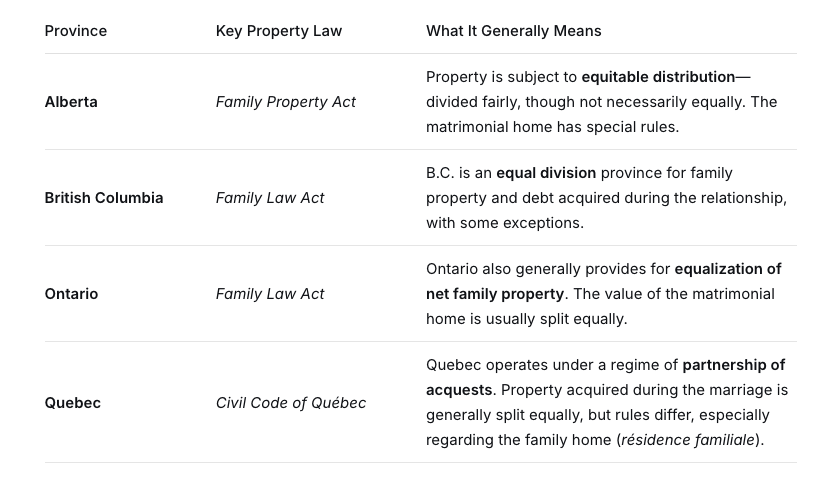
Your move: Always consult with a family lawyer in your specific province before making any agreements. A separation agreement is essential, and it must be rock solid before we can use it for a mortgage solution.
Financial Strategies: Managing the Mortgage Post-Separation
Here’s the part where we roll up our sleeves. Whether you want to stay in the home, buy your ex out, or just walk away clean, you need to know what’s possible. Let’s walk through the three main paths we guide clients through across the country.
1. Refinancing the Mortgage
This is often the first option people ask about—and for good reason. Refinancing means you take the current mortgage, pay it off completely, and replace it with a new one in your name only. It’s the clearest way to untangle things.
You can typically borrow up to80% of your home’s current appraised value with a standard refinance. You’ll need enough equity to make this work—especially if you're planning to pay your ex a lump sum as part of the agreement.
What you’ll need across Canada:
Proof of income (salary, self-employed, etc.)
Good credit (ideally 680+ for the best rates)
A recent appraisal or valuation
A signed separation agreement (lenders will likely ask for it)
This is a good fit if there’s enough equity (at least 20%), and you’re ready to stand on your own financially.
2. Spousal Buyout Mortgage (The Lifeline Option)
Now, this is where it gets interesting—and where a lot of people don’t know they have options. A spousal buyout mortgage is a very specific program, built just for situations like yours. It allows one partner to stay in the home and pay the other out—even if you don’t have 20% equity.
With this, you can borrow up to95% of your home’s value. But here’s the catch—that extra 15% (the portion above 80%)has to go directly toward paying out your ex. You can’t use it to renovate or consolidate debt. It’s strictly for equity transfer.
You’ll need:
A signed separation agreement (this is mandatory)
A full appraisal
Documentation of income (yes, child support counts if it's formal and consistent)
We had a client in Ontario—a teacher in Burlington—who came to us thinking she had no shot at keeping the house. A standard refinance couldn't give her enough to buy out her ex. We switched strategies and used a spousal buyout program. With a formal agreement, an appraisal, and proof of her income (plus child support), she stayed put, bought him out, and avoided uprooting her kids. She told me, "I thought it was over. That one product changed everything."
3. Selling the Property
Sometimes, the cleanest move—emotionally and financially—is to sell. I say this to a lot of people who are trying to hold on out of guilt, fear, or pressure. But if the home is a financial stretch on your own, or you’re both at a standoff?Selling can be the reset button.
When you sell, the mortgage gets paid out, and whatever is left over (after realtor fees, legal costs, and potential penalties) gets split as outlined in your separation agreement. It’s a fresh start.
What to consider:
Is the home realistically affordable on one income?
Will the proceeds from the sale in your local market (Vancouver, Toronto, Montreal, or a smaller city) help or hurt your next step?
Do you have a realtor and mortgage broker working together on the timeline and math?
Emotional Considerations: Navigating the Transition
Let’s not sugarcoat it—separation is emotionally exhausting. It’s not just about legal documents or who pays what. It’s the quiet moments, the unraveling of routines, and the raw fear of not knowing what’s next. We see this every day with our clients across the country, and we want you to know:you are not alone, and how you feel is valid.
This isn’t just a financial transaction—it’s a life shift. And the way you handle the emotional side of this transition will shape how you come out the other side. That’s why part of our job isn’t just mortgage strategy. It’s helping you feel grounded, even when everything else feels like it’s shifting under your feet.
One client from Lethbridge told me, "The mortgage stuff was actually the easiest part—because it gave me something I could control." That stuck with me. Your emotional health and your financial decisions are linked. If we can get you one step closer to clarity, that’s a win we’ll take every time.
Case Study: Lisa’s Journey to Financial Independence
Let’s go back to Lisa, the client I mentioned at the start.
Background: Lisa, a 38-year-old mom from Airdrie, Alberta, shared a home and a $420,000 mortgage with her ex. Post-separation, she moved out, thinking signing off the title was enough. It wasn’t—her credit dropped because the old mortgage still showed on her file, and she couldn’t qualify for a new one.
Solution: We reviewed her situation. The home had been appraised at $500,000. Instead of giving up, we helped her use a spousal buyout mortgage. She borrowed $475,000 (95% of the value) to pay out her ex, cover legal costs, and refinance solely under her name. She qualified using her income plus documented child support.
Outcome: Lisa owns the home. Her kids have housing stability. And she’s financially independent.
Glossary of Terms
Spousal Buyout: A mortgage product allowing one partner to buy out the other’s equity after separation, often allowing for higher borrowing (up to 95% LTV).
Refinancing: Replacing an existing mortgage with a new one, typically to change the terms, rate, or remove a borrower.
Equity: The home’s current market value minus what you still owe on the mortgage.
Appraisal: An independent valuation of the property required by the lender to support a refinance or buyout.
Separation Agreement: A legal document outlining the terms of your property division, financial support, and other key decisions. Essential for lenders.
Equitable Distribution: A principle (used in Alberta, for example) where property is divided fairly, but not necessarily 50/50.
Equalization Payment: A common concept in Ontario, where one spouse pays the other to balance the net family property.
Frequently Asked Questions
Can I remove my ex-spouse’s name from the mortgage without refinancing?
No. The lender has a contract with both of you. To remove one person, you must pay off the existing mortgage and qualify for a new one in your name only (refinance).
Can I use child support to qualify for a mortgage?
Yes, across all provinces, if it’s legally documented in a separation agreement or court order and you can show it’s been consistently received, typically over the last 3–6 months.
What if I can’t afford to buy my ex out?
You have a few options: negotiate a different settlement, sell the property, or in some cases, agree to a co-ownership arrangement where you both stay on title for a set period until you sell or your situation improves. Talk to your lawyer and us.
Will the old mortgage affect my ability to buy a new home?
Yes, absolutely. As long as your name is on that mortgage, it counts as your debt. Lenders will include it when calculating your debt service ratios for a new purchase, which can severely limit what you can afford. Getting legally released is critical.
Take the First Step Toward Clarity
If you’re separated and your name is still on a mortgage in Ontario, Alberta, B.C., or Quebec, you don’t have to figure this out alone. Give us a call or fill out an application at this link. Our team will get in touch to start building a plan that suits your situation and your goals.
I hope this version captures the right tone and provides the comprehensive, cross-Canada perspective you need. Let me know if you'd like to adjust any sections further.


